
The situation in Minneapolis provides clear examples of the violence of rapidly evolving state authoritarianism. And has shown surprising and effective responses to the violence by the people there. Demonstrating the concepts of the NewCO (new conscientious objector) and ‘active objection.’
Significance of Minneapolis
I’m bringing this up in the context of the violence of militarized policing in Minneapolis. Because of the amazing, peaceful and effective responses from the people there. Demonstrating a shift from resistance to ‘active objection‘, instead.

The 1968 Richmond Declaration redefined non-compliance
I’m telling the story about the 1968 Richmond Declaration on the Draft and Conscription here, because that represented a significant change is how (some) Quakers thought about our responses to war. The result was a call to reject the privileges Quakers often received, allowing them to do two years of alternative civilian service instead of combat. And calls for the abolition of conscription itself.
In high school (class of 1970) I spent a lot of time studying and praying about what I should do about the requirement for males to register with the Selective Service System, the military draft, when we turn 18 years-of-age. I was aware of the significance of this decision, which would, and did, determine which path my life would follow.
I saw the draft decision as a choice between doing what I believed was right or taking the easy way out. Was I willing to risk imprisonment by turning in my draft card, or would I consent to do two years of alternative (civilian) service under the Selective Service System?
I knew Quaker men who were imprisoned for refusing to cooperate with the miliary. One was a classmate of mine from Scattergood Friends School. I turned in my draft card, but wasn’t prosecuted for doing so. Our stories, and those of other Quakers facing conscription were collected by Iowa Quaker, Don Laughlin (see below).
A national conference of Quakers met at Earlham College in Richmond, Indiana, in 1968, to consider what Quakers should do in the face of the Vietnam War. I attended that conference, representing Scattergood Friends School.
An historic shift in Quaker thought and practice
The 1968 Richmond Declaration redefined non-compliance by rejecting the “privileged status” of traditional Conscientious Objection and calling for the total abolition of the conscription system itself.
Friends Coordinating Committee on Peace has announced a national conference on the draft and conscription to be held at Earlham College (Richmond, Indiana), October 11th through 13th. It is primarily planned as a working conference, with about 180 representatives from Yearly Meetings, Friends schools and other Friends’ organizations and seventy to a hundred additional Friends appointed at large. A detailed program and other information may be obtained from FCCP, 1520 Race Street, Philadelphia, 19102.
Friends Journal 8/15/1968
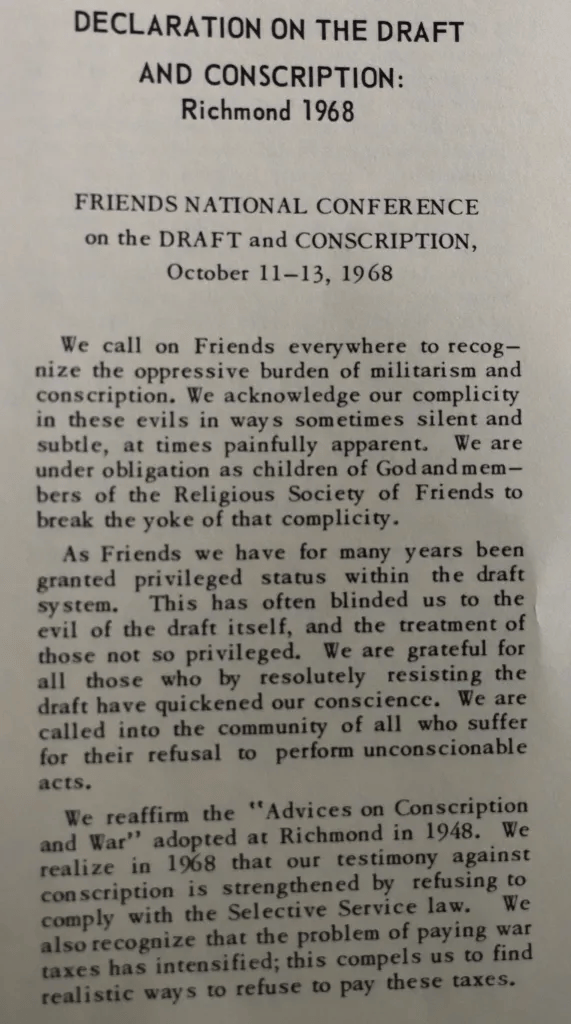
We call on Friends everywhere to recognize the oppressive burden of militarism and conscription. We acknowledge our complicity in these evils in ways sometimes silent and subtle, at times painfully apparent. We are under obligation as Children of God and members of the Religious Society of Friends to break the yoke of that complicity.
As Friends we have for many years been granted privileged status within the draft system. This has often blinded us to the evil of the draft itself, and the treatment of those not so privileged. We are grateful for all those who by resolutely resisting the draft have quickened our conscience. We are called into the community of all who suffer for their refusal to perform unconscionable acts.
Declaration on the Draft and Conscription, Richmond 1968
From Privilege to Abolition
The 1968 Richmond Declaration redefined non-compliance by rejecting the “privileged status” of traditional Conscientious Objection and calling for the total abolition of the conscription system itself.
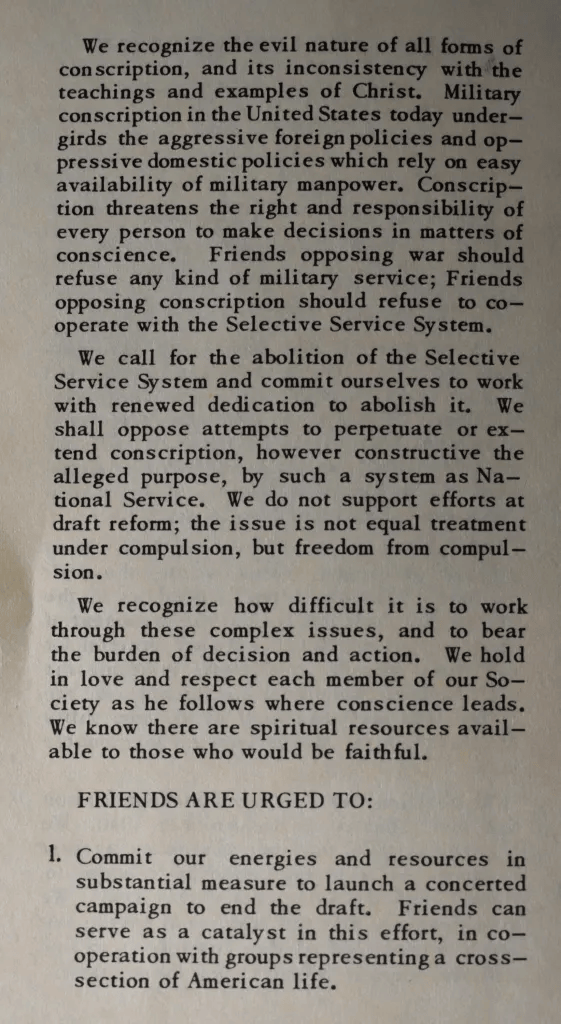
1. The Rejection of Privilege The Declaration acknowledged that the special status granted to Quakers (Conscientious Objector classification) had “blinded” the community to the evil of the draft itself. It redefined non-compliance not as seeking a personal exemption from sin, but as refusing to accept a privilege that was denied to the poor and non-religious. The signatories believed that cooperating with the draft, even as a recognized CO, made one “part of the power which forces our brothers into the military”.
2. From Reform to Abolition The Declaration explicitly stated, “We do not support efforts at draft reform; the issue is not equal treatment under compulsion, but freedom from compulsion”. This shifted the goal from making the draft “fairer” for pacifists to making the draft obsolete. It committed the body to work for the total “abolition of the Selective Service System” rather than seeking comfortable niches within it.
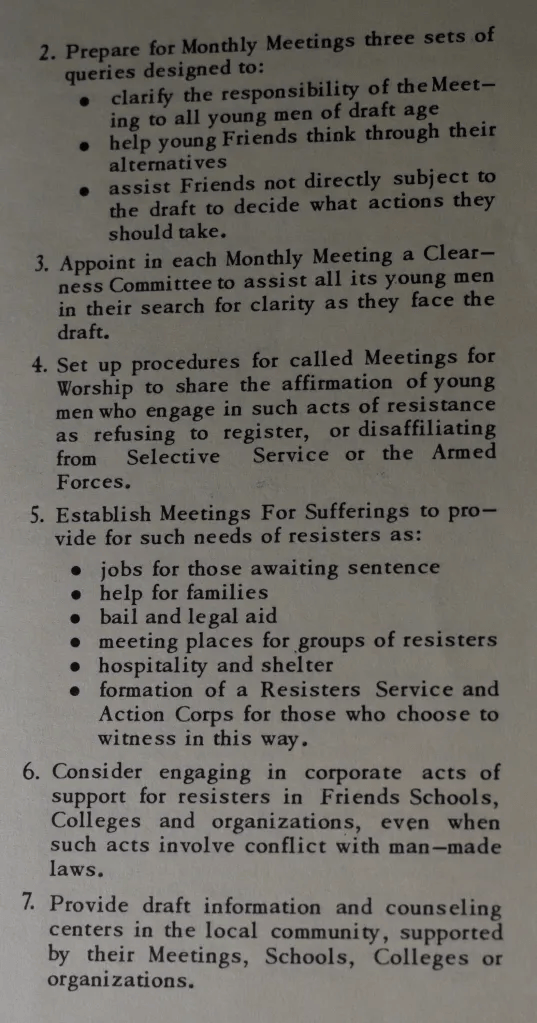
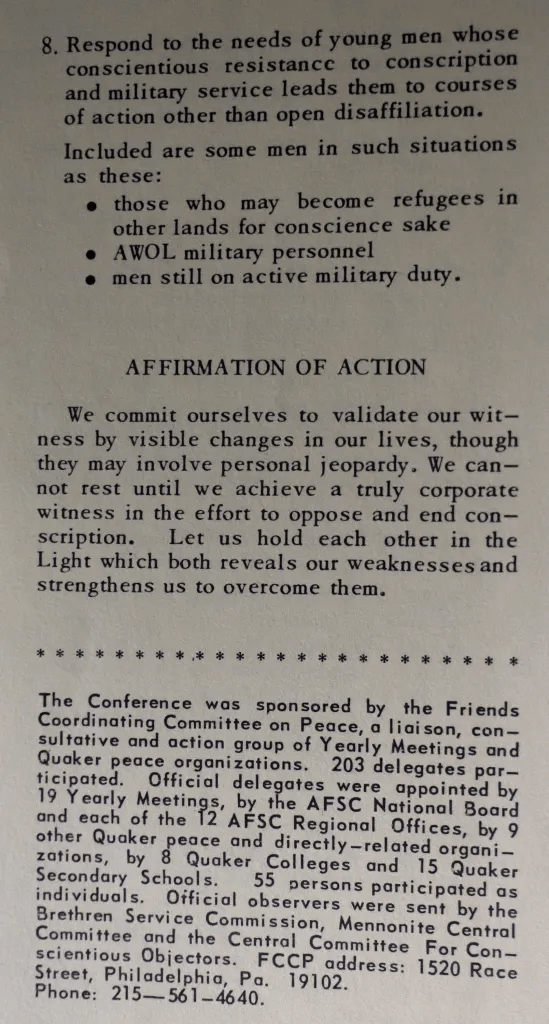
3. Active Non-Cooperation The Declaration moved beyond “Static Objection” (refusal to carry a gun) to “Active Objection” (refusal to cooperate with the logistics of conscription). It urged Friends to refuse to register, to return draft cards, and to refuse to fill out Selective Service forms. This validated the view that “fidelity to Truth” required breaking the law when the law itself was a mechanism of oppression.
4. Institutional Support (Meeting for Sufferings) It redefined the role of the Meeting from a place of passive worship to a hub of risk absorption. The Declaration called for the establishment of “Meetings for Sufferings” to provide bail, legal aid, jobs, and shelter for those who faced prison for their non-cooperation. This effectively operationalized the concept of “Communal Risk Absorption,” ensuring that individuals did not face the Enforcer alone.


Stories of Young Quaker Men Facing War and Conscription
Collected by Don Laughlin


