I’ve watched in horror as militarized police and National Guardsmen are being deployed to our cities and communities. This is the latest episode of advancing authoritarianism under the current administration. We now have a war at home.

Or more accurately, more of us are now in the cross-hairs of state oppression and violence. White privilege no longer protects those who are White. Those who are not White have always suffered from the integrated systems of Christian, colonial, capitalist violence (CCV).
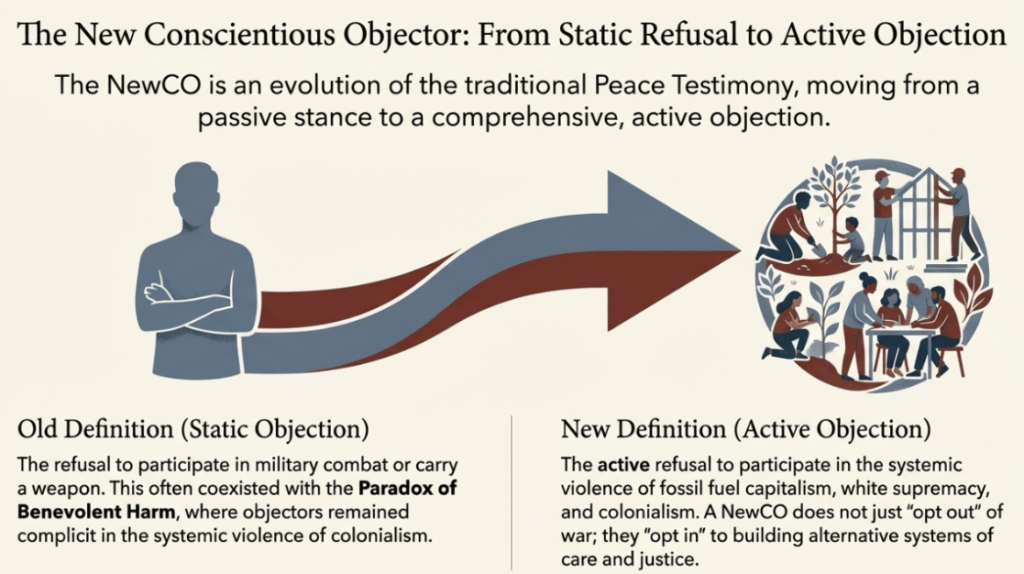
This is why I’ve been led to the concept of the NewCO (new conscientious objector), because that is the response to CCV. It isn’t important that people use the term NewCO, but I’ve been led to that term because it reflects a conscientious objection approach for today, based upon the concept of conscientious objection to war in the past. The NewCO is about mutual aid, LANDBACK and the Abolition of police and prisons. Thus far, I’ve been writing mostly about mutual aid, and about LANDBACK.

Abolition
Most people are apprehensive when they hear about the abolition of police and prisons. They think they are safer with policing and prisons. Most see prisons as a way to remove ‘criminals’ from society.
But the current escalation of policing violence is showing the fallacy of relying on police for safety to those who didn’t already know.
Those of us who are old enough remember that when we were growing up that there was very little police presence in our communities. There were no mega-prisons or the routine use of solitary confinement. No prisons for profit. No school to prison pipeline.
The New Conscientious Objector (NewCO) recognizes that the modern Peace Testimony must expand beyond a refusal of military service to a withdrawal of consent from the entire carceral state. Because the carceral state is a form of systemic, state-sanctioned warfare against the poor and marginalized, a NewCO responds by divesting from these violent institutions and investing in community-based alternatives like the Great Plains Action Society’s Healing Justice House, or Bear Creek meeting’s work on a mental health center.
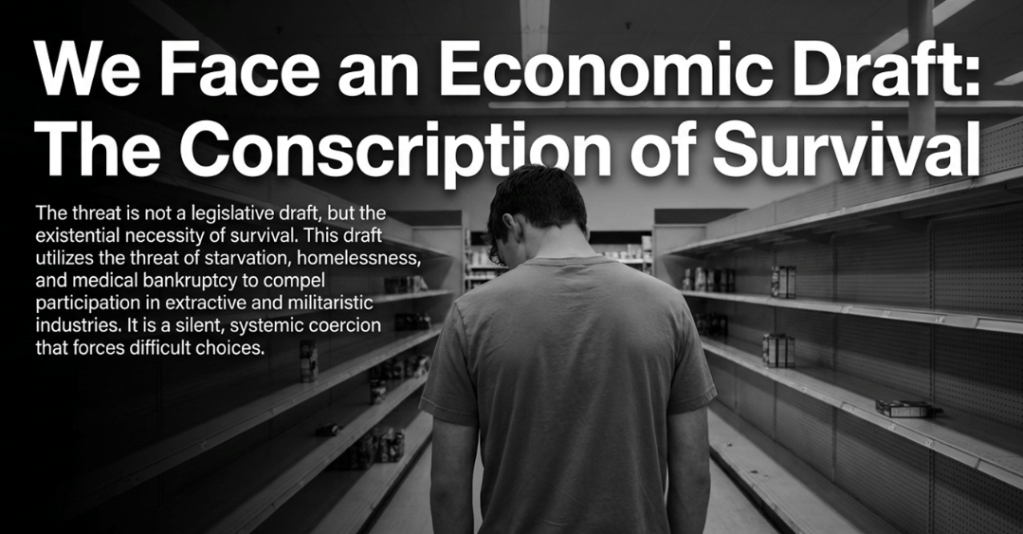
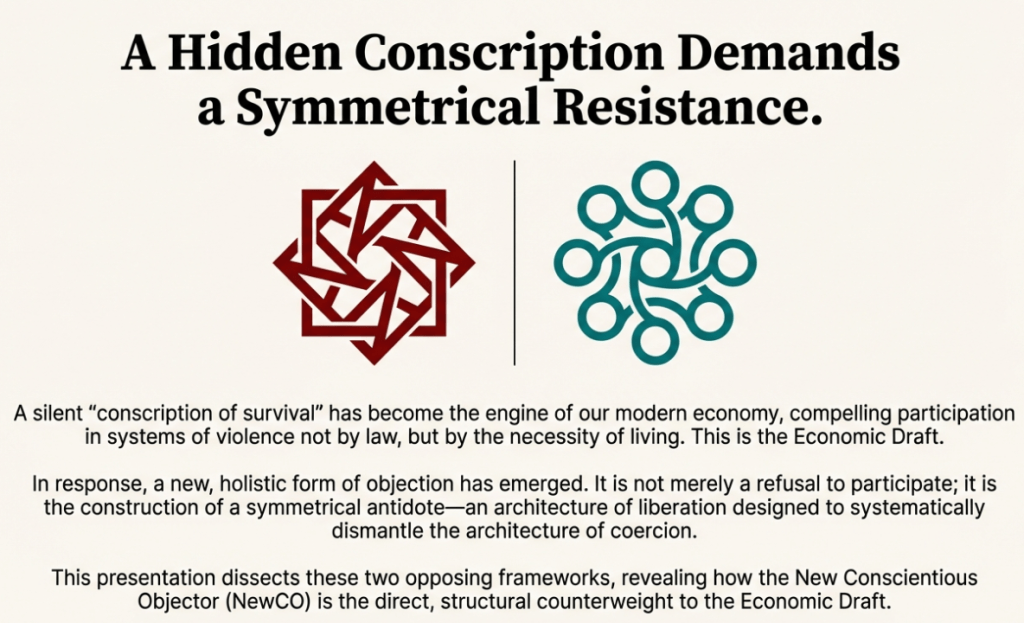
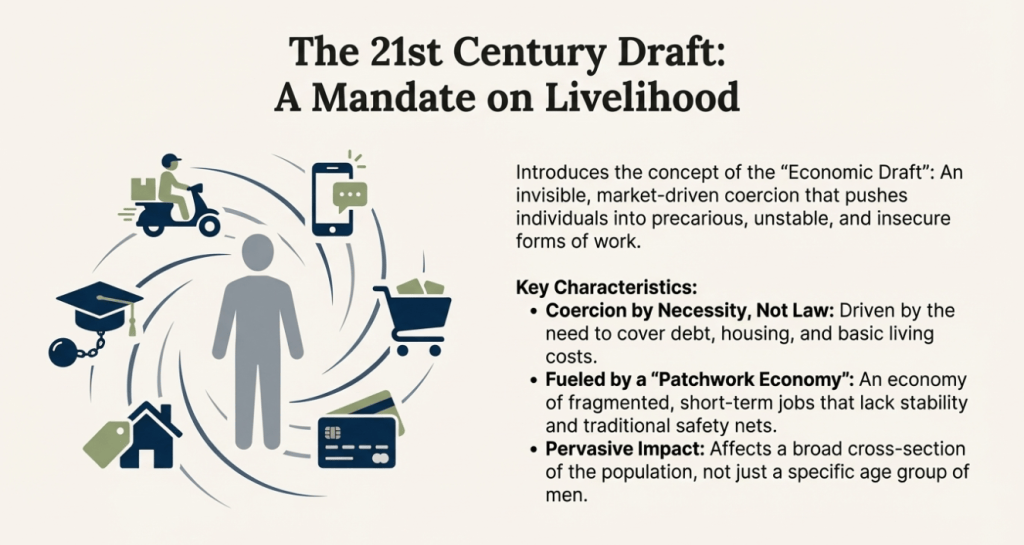
Abolition is the removal of the enforcer. Without the police to enforce the threat of destitution, the state loses its power of coercion. Mutual Aid provides the “rations” that allow a NewCO to desert the Economic Draft, while Abolition removes the enforcers who would punish that desertion. (see more about the Economic Draft here: https://newconscientiousobjector.com/?s=economic+draft )
The abolition of police and prisons is an expansion of the Quaker Peace Testimony.

The Peace Testimony today requires us to respond to the reality that the “occasion of war” is often found in the economic desperation and state coercion of our own neighborhoods. Integrity demands that we recognize the “Pennsylvania System” as a catastrophic failure of benevolent intent. We must now work to dismantle the very carceral structures our ancestors helped build.
Quaker’s belief in “that of God in everyone” is fundamentally incompatible with a system that cages human beings for being poor. The NewCO understands that freedom is not merely emancipation from a cell, but the creation of a Social Solidarity Economy that makes the state’s monopoly on care irrelevant. When we build a Community Land Trust or a “Panther Pantry,” we are engaged in the spiritual work of taking away the occasion of war by removing the economic weapons used against our neighbors. Our Meetinghouses could become hubs for this response, to become active sites of sanctuary and supply.
Modern American prisons originated from Quaker ideology, specifically William Penn’s “Great Law” of 1682, which established rehabilitation over punishment as the primary goal. However, this legacy proves that the same Quaker principles that sought humane reform ultimately contributed to creating the modern penitentiary system that many contemporary Quakers now view as fundamentally flawed. Canadian Quakers made history in 1981 by becoming the first religious body to call for complete prison abolition, declaring that “the imprisonment of human beings, like their enslavement, is inherently immoral”. This position represents a radical evolution from our ancestors’ support for prison reform to complete rejection of incarceration as a solution.

Canadian Yearly Meeting of the Religious Society of Friends
Minute on Prison Abolition
The following was approved by Canadian Yearly Meeting of the Religious Society of Friends in 1981
(Minute 93).
We approve the following Statement on Friends Response to Crime:
Friends, partly through their own experiences in the prisons of the seventeenth century, became concerned about the treatment of the accused or convicted. Friends witnessed to their concern for the Divine Spirit in humans by seeing prisons as an alternative to corporal or capital punishment. Subsequently, they worked for reform of these prisons. Today, Friends are becoming aware that prisons are a destructive and expensive failure as a response to crime. We are, therefore, turning our efforts to reform prisons to efforts to replace them with non-punitive, life-affirming and reconciling responses.
The prison system is both a cause and a result of violence and social injustice. Throughout history, the majority of prisoners have been the powerless and the oppressed. We are increasingly clear that the imprisonment of human beings, like their enslavement, is inherently immoral and is as destructive to the cagers as the caged.
The challenge before us is to use alternatives based on economic and social justice and on the fulfillment of human needs. Some alternatives to prisons have already been developed and more are needed to bring about reconciliation and healing within the community. Friends need to seek out, develop and support such programs. At the same time, we need to foster awareness in ourselves and others of the roots of crime and violence in society to ensure that our lives do not unintentionally reinforce these evils.
Prison abolition is both a process and a long-term goal. In the interim, there is a great need for Friends to reach out to and to support all those affected: guards, prisoners, victims and families. We recognize a need for restraint of those few who are exhibiting dangerous behaviour. The kind of restraint used and the help offered during this time must reflect our concern for that of God in every person.”